Email production
Email production and HTML email development
Email production at 4:59 is the design, coding, testing and deployment of email templates and campaigns, done by a team that builds email every week. We create modular and dynamic template systems, code HTML email that renders across clients, handle multi-brand and multi-language builds, and deploy in your own platform. It is for marketing teams whose email volume has outgrown their production capacity or whose template library has become hard to manage.
What’s included
Everything you need, from one team.
Modular template systems
Libraries of reusable modules, such as headers, hero stories, article lists, product grids, offers and footers, each with defined variations and coded to a shared mobile-first grid. Every module is tested on its own, so any combination produces a working email.
HTML email development
Hand-coded, table-based HTML with inline styles, conditional code for specific clients and fallbacks where media queries are ignored. It is built by developers who code email every week, so it holds up in Outlook, Gmail, Apple Mail and mobile apps.
Dynamic content
Modules that switch content by segment, brand, language or data field, using the conditional logic your platform supports and data it already holds. Personalization fields get fallbacks, and we check that each segment sees the right content.
Multi-brand and multi-language builds
One shared architecture, with brand styles held in a small set of settings and copy pulled from translation files or content blocks. Layouts leave room for longer translations. For IHG this approach supports 13+ brands and 27 languages.
Template library consolidation
We audit every template you use and the job it does, then group those jobs into a smaller set of modular systems. For Pimco that meant more than 30 templates down to 7. Live programs keep sending while the new system rolls out.
Rendering and QA testing
Previews across desktop, webmail and mobile clients, in light and dark mode, with images on and off. We check links, tracking, personalization, dynamic modules, alt text, reading order and color contrast, and a producer signs off on the final proof.
Platform loading and deployment
Modules loaded into your platform, data fields and dynamic rules set up, audiences and suppressions built, and sends scheduled on an agreed calendar. We route proofs to reviewers, track approvals and confirm each send, or deliver production-ready code to your team.
Documentation and training
Build guides and a module reference that shows every block, its variations and what is safe to change, plus training for the people who build your emails. Your team can assemble and edit emails without breaking the code.
How it works
A fixed date and a named owner, from day one.
- 01
Template audit
We inventory your current templates, campaigns, platform setup and the email clients your audience actually uses.
- 02
Module design
We design a module library around the jobs your emails do, with variations for each brand or program.
- 03
Code and test
We code each module, test it across clients and devices, and fix rendering issues before anything is loaded.
- 04
Load and train
We load the system into your platform, build the first campaigns with your team and hand over documentation.
- 05
Ongoing production
We build, check and deploy campaigns on your calendar, and add or retire modules as needs change.
Technology at every step
Where AI speeds this up, and where people check it.
Automated rendering checks
Every build is previewed across email clients, devices and dark mode automatically. A developer reviews the results and fixes what the screenshots reveal.
Link, tracking and alt text validation
Scripts check every link, tracking parameter, personalization field and image alt attribute before a proof goes out. A producer signs off on the final proof.
AI-assisted versioning
Adapting one email into many language, brand or segment versions is faster with AI-assisted versioning. Native-language reviewers and brand owners check each version.
Template audit scripts
Scripts compare the code and structure of an existing template library to find duplicates and near-duplicates. Our team decides which modules to keep, merge or retire.
The work
Email production, in practice.
Email program
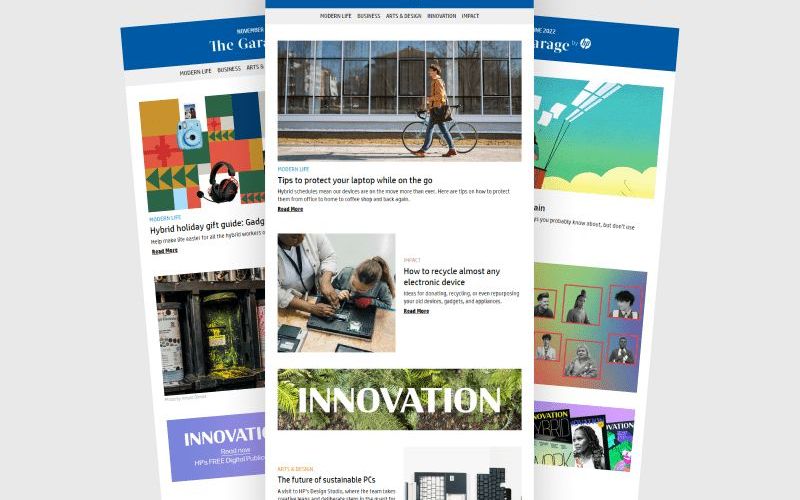
HP: a global newsletter for The Garage
Strategy, modular templates and campaign management, with testing that lifts KPIs month over month.

Email program
Focus Features: a studio newsletter, fully managed
A newsletter program that pairs exclusive content with timely, personalized information, run end to end.
FAQ
Questions we hear a lot.
What is email production?
Email production is the design, HTML coding, testing and deployment of email templates and campaigns. At 4:59 it covers modular and dynamic template systems, multi-brand and multi-language builds, rendering and accessibility QA, and loading and sending campaigns in your own email platform. The work is done by people who code email every week, because HTML email follows different rules from the web. It suits teams that need more email capacity or a better template system.
Can 4:59 deploy emails in our existing platform?
Yes. We load templates and build, schedule and send campaigns in the email platform you already use, so your data, lists and sending reputation stay in your account. That includes setting up data fields and dynamic rules, building audiences and suppressions, sending test proofs and confirming each send went out as planned. If your platform connects to Salesforce, Pardot or another CRM, we map the fields our templates use. For Focus Features we run weekly deployments.
Can 4:59 act as our extended email production team?
Yes. Email production is part of our production support offering, so we can work as an extension of your team. Some clients bring us in to build a new template system and then hand it to their team. Others have us produce and deploy every campaign, or keep deployment in-house and take production-ready code from us. Each build has a fixed date and a named owner, and nothing reaches an inbox without passing QA.
What is a modular email template?
A modular email template is a library of tested, reusable blocks, such as headers, hero stories, article lists, product grids and footers, that your team assembles into emails. Each module has defined variations and is tested on its own, so any combination works. Builds get faster, design stays consistent and you can test one change at a time. We built this kind of architecture for HP The Garage's global newsletter, and designed e-commerce email templates for Bing Shopping.
Why do emails look different in Outlook, Gmail and Apple Mail?
Each email client renders HTML with its own engine and its own limits. Desktop Outlook uses a word-processing engine, some webmail clients strip parts of your CSS, mobile apps resize content in their own ways and dark mode can invert colors. That is why a web developer can build a page that falls apart in Outlook. Reliable email uses table-based layouts, inline styles, client-specific conditional code and testing across clients before every send.
Can one template system support multiple brands and languages?
Yes. One shared architecture carries the structure, and a layer of brand and language settings changes logos, colors, type, copy and imagery by version. Layouts leave room for longer translations, and we test languages that change direction or need different fonts before launch. Every version is checked against its source, with native-language review where your team provides it. For IHG we built global dynamic templates that support 13+ brands and 27 languages.
What does email QA and rendering testing cover?
Email QA covers how the email looks, whether everything in it works and whether everyone can read it. We preview across desktop, webmail and mobile clients, in light and dark mode, with images on and off. We confirm links and tracking, personalization fallbacks and dynamic content for each segment. Accessibility checks cover live text, alt text, reading order, layout tables and color contrast. A producer reviews the final proof before it is scheduled.
How many email templates does a brand need?
Fewer than most brands have. A modular system can cover newsletters, promotions, events and transactional messages with a handful of templates, because modules handle the variety. Consolidate when teams spend more time choosing, fixing or recreating templates than building emails. For Pimco we consolidated more than 30 templates into 7 in a global email strategy, design and production overhaul, giving teams one place to fix issues. We plan migrations so live programs keep sending.
How does 4:59 use AI and automation in email production?
We use automation to preview every build across clients and dark mode, validate links, tracking, personalization and alt text, and compare template libraries during audits. AI-assisted versioning speeds up language, brand and segment versions. Developers fix what the checks find, reviewers check every version, and a producer signs off on each proof.
Related services
Often paired with
Email marketing
Newsletters that grow a fan base, plus acquisition email and automation: planned, designed, produced and measured.
Explore email Email marketingNewsletter and fan programs
Newsletter strategy, cadence, tone, design, list growth, subscriber journeys, managed deployments and reporting for entertainment and B2B brands.
Explore newslettersWebsite design and development
Flexible sites for growth businesses, designed and built in WordPress, Webflow or a headless CMS, then kept fast.
Explore websitesTell us the deadline. We'll beat it by a minute.
Share the brief for your email production project and we'll come back with a plan, a team and a timeline.